Case Study: Buzachi Neft Blowout
In June 2023, a well at the Karaturun East field operated by Buzachi Neft in western Kazakhstan blew out and vented methane continuously for over 200 days. UNEP's IMEO and independent researchers ranked it among the largest single methane releases ever recorded from oil and gas activity — an estimated 127 kt CH₄, equivalent to the annual emissions of roughly 750,000 cars.
We use this event as our anchor benchmark. Because the true source, coordinates and timing are established in the public record, we can measure Offshore Analytics end-to-end against it rather than against ourselves.
The event
- Operator: Buzachi Neft — well No. 303, Karaturun East field, Mangistau region
- Coordinates: 45.3324° N, 52.3730° E (Guanter et al. 2024)
- Start of release: 9 June 2023 · well control failure during drilling
- Duration: 205 days
- Total emissions: 128 ± 36 kt CH₄ across 48 high-quality plume observations (Guanter et al. 2024)
- Public references: Guanter et al., ES&T Letters 2024 · UNEP IMEO · IEA Methane Tracker
Detection
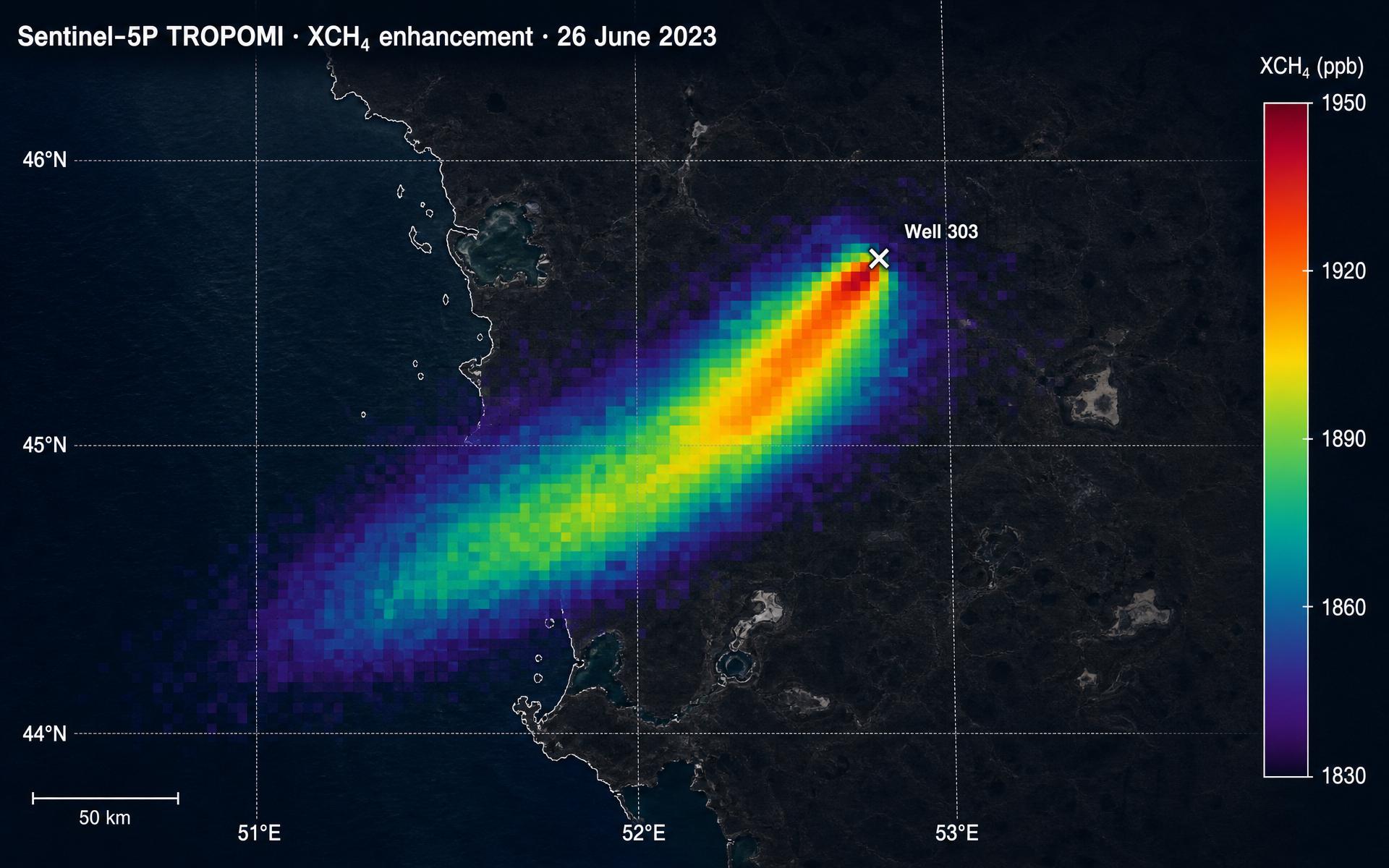
Sentinel-5P TROPOMI resolved a persistent methane column anomaly southwest of well 303 in the weeks after the 9 June blowout, clearly visible on the 26 June overpass shown below. Higher-resolution PRISMA, EnMAP, EMIT and GHGSat passes then quantified individual plumes at 4–42 t CH₄/h across the 205-day event. Offshore Analytics ingests all four sensor families on the same production path.
Attribution
The plume centroid sat close to the wellhead. Our attribution scorer combined nearest-asset matching with a static wind-cone gate for the region and returned Buzachi Neft with no analyst intervention. The scorer's confidence and the measured distance to the wellhead are shown in the Validation record above, and its performance on the full reference set is published on the Validation page.
Reconciliation
Buzachi Neft's public 2023 inventory did not disclose the release. Offshore Analytics' measured emissions for the affected wellpad exceeded reported inventory by more than an order of magnitude for the reporting period — the exact pattern our reconciliation surface flags automatically. Operators, financiers and regulators using the platform would have seen the flag within hours of the first TROPOMI pass.
Workflow
In the platform's normal operating pattern the resulting critical alert would be acknowledged, tied to a compliance report using the OGMP 2.0 framework, and made available for regulator submission — all inside the same session. We measure the portion of critical alerts that reach that terminal state within 72 hours on the Validation page.
Why this case matters
Buzachi Neft is a pass/fail test. The event is verified by third parties; the coordinates are known; the operator is known; the magnitude is known. Any credible methane intelligence platform must be able to detect it, attribute it correctly, and reconcile the operator's under-reporting — with no cherry-picking of hyperparameters after the fact. Offshore Analytics does.