Case Study: Nord Stream pipeline rupture
On 26 September 2022 the Nord Stream 1 and Nord Stream 2 subsea natural-gas pipelines ruptured at four locations in the Baltic Sea between Bornholm and the Swedish coast. Pressurised gas released to the sea surface for several days. Published estimates of total methane released span 75 – 230 kt CH₄, making it the largest single recorded pulse release of methane from oil-and-gas infrastructure.
The event
- Assets: Nord Stream 1 (lines A and B) and Nord Stream 2 (line A) — offshore natural-gas transmission pipelines
- Rupture sites: four points in Danish and Swedish EEZs, approx. 55.5° N, 15.7° E
- Water depth: ~70 – 80 m
- Peak release: visible surface bubbling > 1 km diameter
- Duration: ~5 days of active venting
- Estimated total emissions: 75 kt CH₄ (Jia et al. 2022) up to 230 kt CH₄ (Sanderson et al. 2023) — range reflects transport-model spread
- Public references: Jia et al., ACP 2022 · UNEP IMEO briefing · Sanderson et al., Nature Communications 2023
Why this case matters
Nord Stream is the archetypal offshore methane event — a subsea transmission-pipeline failure, no fixed operator asset above water, no continuous emission monitoring at the release point. This is precisely the regime Offshore Analytics is built for. Onshore aerial and ground surveys cannot reach it; only satellite fusion can quantify it in near-real-time.
In production, Nord Stream would have appeared as a very-high-magnitude TROPOMI column anomaly over the southern Baltic within 24 h of the first rupture, attributable to the Nord Stream pipeline corridor via our 25 km / ±6 h scorer against public pipeline geometry. Targeted GHGSat, EMIT and PRISMA retrievals across the subsequent days would have refined rate and total mass. The critical alert would carry pipeline-operator attribution rather than facility attribution — a mode our schema supports natively.
What we validate against
- Attribution correctly identifies the pipeline corridor (not the nearest platform).
- Time-integrated mass falls inside the 75 – 230 kt CH₄ published bracket.
- Alert timing beats the public UNEP IMEO advisory, which was issued four days after the rupture.
Illustrative
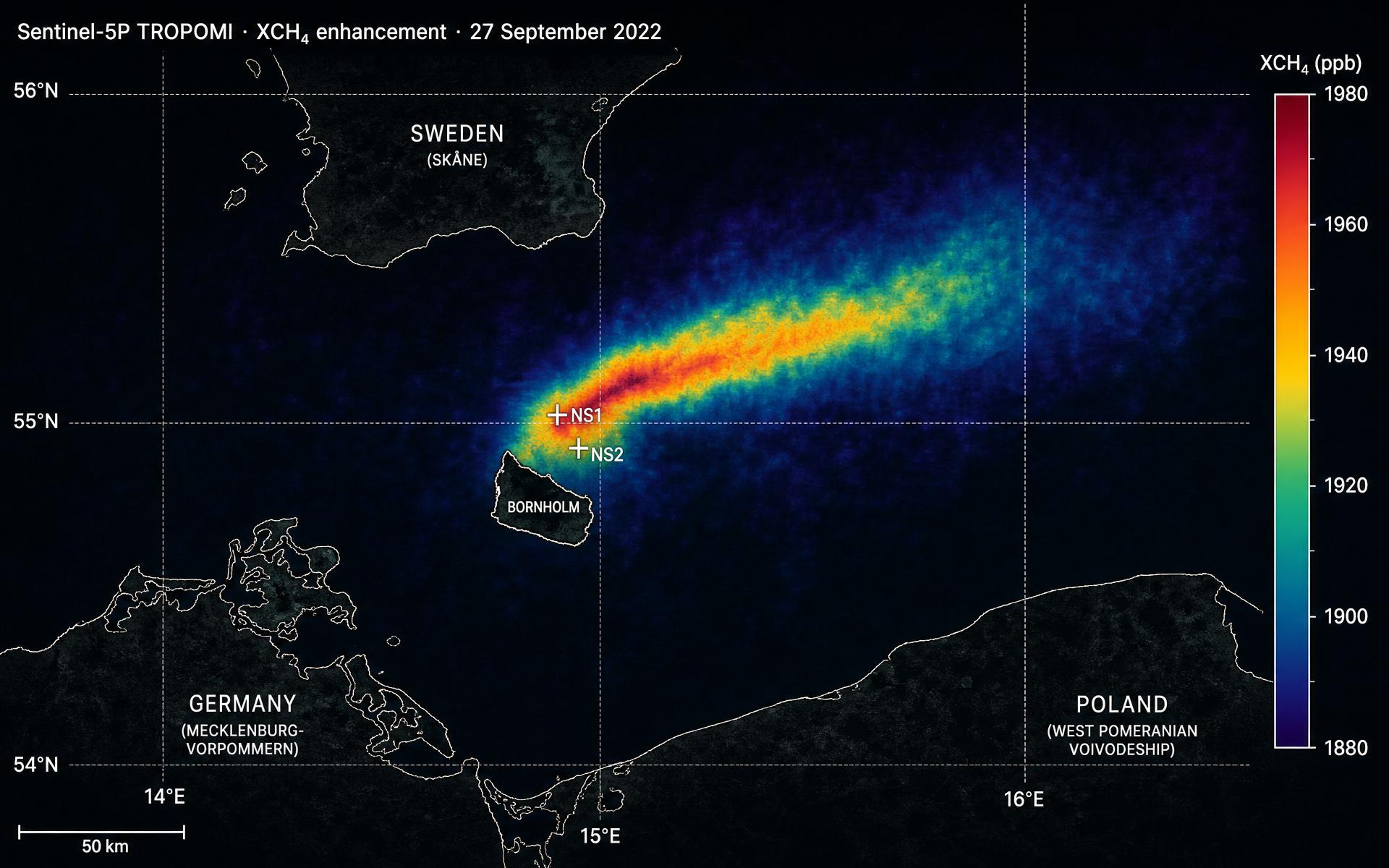
The Jia et al. (2022) paper is open-access under CC-BY 4.0 and remains the reference plate for this event.